- Extraction systems
- Workplace extraction
- Extraction system service
- Complete plant construction
- Sustainability
- Spare parts and accessories
- Fire protection and explosion protection
- Pre-separator
- Industry solutions
- Industrial steel construction
- Industry solutions
- Allergic reactions of the respiratory tract, e.g. asthma
- Chronic diseases of the upper respiratory tract
- Dust lung or cancer of the lung tract
- Inhalable particulate matter PM10: smaller than 10 μm (micrometers)
- Respirable particulate matter PM2.5: smaller than 2.5 μm (micrometers)
- Respirable particulate matter PM1: less than 1 μm (micrometers)
- Ultrafine particles UP: smaller than 0.1 m μm (micrometers)
- refer to concentrations in the air or in the body
- show when companies need to make adjustments
- are adapted to the latest findings
 Fresh air thanks to the Clean Air Ordinance
Ordinance on Air Pollution Control (LRV)
The Ordinance on Air Pollution Control (LRV) stipulates that emissions such as particulate matter (particle sizes PM10/PM2.5) produced in industrial processes must be fully recorded directly at source, i.e. at the point of origin. It calls for a precautionary limitation of emissions. The use of extraction and filter systems ensures compliance with the specified limit values, known as MAK values.
FINE DUST IS HARMFUL TO HEALTH
Emissions such as dust, fibrous materials, e.g. asbestos or artificial mineral fibers, gas or smoke can lead to occupational diseases, some of which result in incurable damage and high costs:
Particulate matter and impact on health
In addition to the chemical composition, the particle size is particularly important for the health-related assessment of particulate matter. These dusts are divided into the following categories based on their particle diameter:
The particle size determines whether a dust particle can be inhaled or where in the respiratory tract it is deposited and causes damage to health.
Impact of particle size on our health
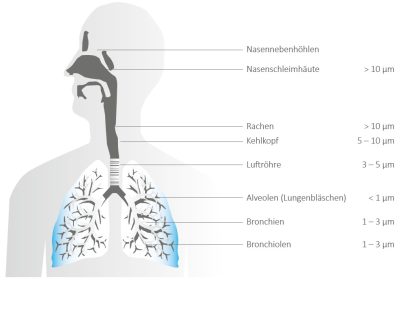
Around 50 percent of particles with a maximum size of 10 μm (PM10) are deposited in the tracheobronchial area, i.e. in the windpipe and bronchi. As the particle size decreases, the proportion that reaches the alveoli – the air sacs in the lungs – increases.
Studies indicate that particles as small as 1 μm and ultrafine particles smaller than 0.1 μm (100 nm) penetrate the wall of the alveolar vesicles and thus enter the blood. Particles up to a size of 1 μm are absorbed by the red blood cells.A high proportion of aerosols in the air we breathe can have harmful effects on our health and lead to bronchitis, cardiovascular diseases and allergies.
Source: LfU / UMEG
Conclusion
This makes it all the more important that air pollution control (LRV) can be implemented in the manufacturing industry by using an extraction and filter system that efficiently filters dust-laden process air.
MAK VALUES AND SUVA
In order to protect employees from chemical exposure, Suva determines the limit values at the workplace in Switzerland in accordance with the Ordinance on the Prevention of Accidents and Occupational Diseases (VUV). These are referred to by the abbreviations MAK value (maximum workplace concentration value) and BAT value (biological workplace tolerance concentration value).
These limits:
DEFINITION MAK-VALUE
The MAK value is the maximum permissible average concentration of a gaseous, vaporous or dusty working substance in the air, which, according to current knowledge, does not generally endanger health when exposed during a working time of 8 hours per day and 42 hours per week, even over longer periods.
suva – LIMIT VALUES AT THE WORKPLACE
You can find useful information and notation on limit values in the workplace at suva.ch
Your contact persons
Do you need advice or do you have a project?

Gregor Staubli
Verkauf | Geschäftsleitung
Verkaufsleiter | Mitglied der GL

Pascal Bühler
Verkauf
Technischer Verkäufer


You are currently viewing a placeholder content from Facebook. To access the actual content, click the button below. Please note that doing so will share data with third-party providers.
More InformationYou need to load content from hCaptcha to submit the form. Please note that doing so will share data with third-party providers.
More InformationYou need to load content from reCAPTCHA to submit the form. Please note that doing so will share data with third-party providers.
More InformationYou need to load content from Turnstile to submit the form. Please note that doing so will share data with third-party providers.
More InformationYou are currently viewing a placeholder content from Instagram. To access the actual content, click the button below. Please note that doing so will share data with third-party providers.
More InformationYou are currently viewing a placeholder content from X. To access the actual content, click the button below. Please note that doing so will share data with third-party providers.
More Information
- Industry solutions
- Industrial steel construction
- Industry solutions
- Pre-separator
- Fire protection and explosion protection
- Spare parts and accessories
- Sustainability
- Complete plant construction
- Extraction system service
- Workplace extraction


